Monday, 11 July 2011

2011 is the BIM tipping point

Will 2011 be the tipping point for BIM? Image from www.tvscoop.tv


Over the past couple of weeks there has been a growing amount of interest, discussion and debate about Building Information Modelling. The momentum was started in October 2010, with comments from Paul Morrell about the Government’s ambition to embrace BIM. The Government’s construction strategy, issued in May, formalised this view. As a company that has been evangelising about BIM for several years, it is nice that some of the views we have had are being embraced by others, views that we have been able to share with the industry, along with our learning, during our conversion to a BIM-centric organisation. There are still negative responses to the approach, however there are now a majority of individuals and organisations who accept that BIM is the future and they will have to adopt and invest moving forward.


What I have noticed over recent months is the pace of adoption. Over the past few weeks I have spent time in London and have met with a number of senior individuals from major constructors and consultancies. Many of these organisations have made rapid progress and are driving it through their companies and making it part of their forward strategies.


I believe that our professional institutions have been very slow to respond to these changes. Organisations such as the RIBA and RICS are still grappling with BIM, and this is a concern as they are seen as our industry’s representatives in the public realm. In order to adequately service us as personal and professional representatives, and highlight our position as an industry, these organisations must change their role very quickly, and embrace a position as representatives of a skill set within the whole life cycle of the design, construct and operate that our industry has.


Jack Pringle, the next present of the RIBA, made a great point in Building Magazine last week when he suggested that the Construction Industry Council was an excellent organisation to be the umbrella for the industry bringing together the complete cycle into a single organisation. The CIC has also had opportunity to influence the Government in a way which the professions have not achieved for many years, and this level of mutual respect and understanding is very important as it provides us with an intelligent, measured and coherent voice, particularly relevant at a time when the industry’s involvement public sector projects, such as BSF, have come under fire.


I am really encouraged that the life cycle of a building is now being understood and appreciated. The days of considering the design and construction of a building separate to its capital cost are starting to diminish. Progressive organisations have acknowledged that getting the requirements right in the first instance influences the process of design and construction is very important, and also has a huge impact on the operation and the revenue costs of a building during its life cycle.


_space group has embraced a ‘Big BIM’ approach with a four stage process that takes in this life cycle (www.bigbim.co.uk ), and similar models which adopt similar principles are used in other firms. There is no right or wrong approach to BIM. The important thing is that our industry understands the wider life cycle of a building.


There will still be architects, engineers and constructors who see their role in very narrow terms, rather than embracing this broad spectrum view. However at _space group, our openness to innovation and use of our skills has allowed us to get involved with a whole range of organisations throughout the whole cycle of a project. We are now providing support to sub-contractors, main contractors, other consultants and end users to deliver a more integrated approach which delivers less waste, less cost, less energy and less risk.


As the pace of adoption increases, it is clear that this year will be a BIM tipping point for our industry and those not on board will be tipped out of any meaningful work in the industry.

Wednesday, 1 June 2011

Government Construction Strategy - My Response

The Cabinet Office issued its Construction Strategy yesterday and I have spent the past 24 hours looking through it trying to understand what it means for the industry.
My overriding thoughts are that this is a really welcome strategy, which is long overdue. This government has clearly given consideration as to how it should spend its capital wisely and has pulled together a report which has included collaboration across a number of high level offices within Whitehall, the efficiency and reform group of the Cabinet Office construction sector unit of BIS, as well as Infrastructure UK.

In the past we have suffered from reports which have set out a vision rather than a strategy and plan. This document is different and has some clear, measurable objectives which enable us to move forward as an industry.
Clearly the issuing of the document is only step one and the critical issue now is whether it is adopted by all government departments and becomes central to what the government does.
The focus of the document seems to be very much on internal government procedures and how the government will procure and manage work, and less so on how the construction industry should respond. I believe it is here that the construction industry comes in, and should be capitalising on statements the government has made about benchmarking energy performance and cost, as well as the delivery of all buildings using BIM (Building Information Modelling).

Essentially, the government is setting out its expectations as a client challenging the construction industry, in the same manner as a potential preferred bidder must do, to set out its best response solution.

Traditionally the industry has been very conservative and has not progressed at a pace. Without a doubt, the expectations from government will be high and their benchmarks will be challenging. The industry therefore will have to invest in research, development and innovation. To achieve the levels of capital and revenue cost expected, the industry will have to think completely differently. I anticipate that a kick back from these proposals and only those who are willing to open their mind and think differently will flourish.

Throughout the document there are some very interesting facts and the one that struck me was that there are 300,000 businesses within the construction industry, of which 99.7% are SMEs with over 2 million workers, so clearly the fragmented nature of the industry will cause a problem in generating a holistic response.
The government is intending to establish a board which will be the centre point of this strategy and will communicate with all government departments. This is a much needed initiative in an industry that is so fragmented and does not yet speak with a single voice, so hopefully this will give clarity and direction to the industry.
It is interesting to see that the government has used the terms ‘standardised’ and ‘mass customised product’ in the report. Many organisations and individuals in the industry have fought against such an approach but the government’s advocacy of it is a clear indication of their intention to encourage the construction industry to move forward in this vein.

Another interesting addition is the fact that there is now a linkage between those who design and construct a facility and those who subsequently occupy and manage. Usually this linkage has not existed in any particular way and hopefully with the adoption of BIM the benefits will easily be demonstrated in the savings to revenue.

Across the action plan there are some very straightforward, yet important aspects which will make a considerable difference to the efficiency of the industry. There is a proposal to look at standardised Pre-Qualification Questionnaires (PQQs), such as PAS 91, as well as the potential of standardised procurement and contracts, something not currently prevalent within the industry.
Whilst BSF has been much maligned for its expensive approach, some of the information gained from the initiative was positive and has helped to inform policy. Clearly the idea of another forward plan of capital expenditure is a positive one, and it will allow organisations to invest long term and demonstrate value to client departments.
There also seems to be a willingness to ensure that the correct skills of procurement and management of projects are in place across the public sector, and as long as the individuals with these skills are sourced properly, their presence will ensure continuous learning and realistic expectations.

The idea of having structured cost targets and value criteria is also to be applauded. By collecting data and benchmarking, league tables can be identified and this in turn will help to develop the industry positively. The Movement for Innovation Programme was a good method of demonstrating the best in industry and provided some excellent benchmark data.
As an early adopter of BIM, _space group is pleased to see it mentioned within the strategy. The government clearly recognises the benefit that it will now receive as a client and will legitimise the approach across the construction industry. It is also interesting to see that integrated project insurance has also been considered and will be researched in greater detail in the future.
Overall I think this document clearly sets out what the government will be expecting from the construction industry over the next four years and will encourage a refreshing approach within the industry.
As the government is the single biggest client to the construction industry, spending around £41billion per annum, the industry has no excuse not to respond and achieve the benchmark targets which the government has set out in this report.
I am encouraged to see the report and it gives me hope for a better industry. However I am very realistic about the reticence that there will be across many organisations to adopt some of the proposals made in the report, and that this continues to be a tough time for the construction industry, one that will see many businesses stand or fall based on their decisions over the coming months and years.

Wednesday, 25 May 2011

What future for our industry?

What does the future hold for our industry?


On the front page of the Financial Times yesterday was an article about the incredible decline in construction output during 2011. Overall construction workload fell by a staggering 39%. This is the most significant fall for the past 35 years. There were turnover statistics from several of the major construction companies, including Kier and Balfour Beatty, which indicated the considerable reduction in their construction turnover in the period.


The quarterly GEP figures issued for Quarter 1 suggested that construction output was down by nearly 5% in the period. There are no regionally adjusted figures so I would anticipate that the decline in the regions is far greater as the overall figure will be bettered by investment in the South East.


This catastrophic level of change in any industry will inevitably reshape the future considerably. For the construction industry, clearly we will never go back to the past and the type of industry it was over the past 15 years will not be seen again. We are in a period of flux at present where there is little workload or revenue, but at the same time there are improvements in technology which could reshape how we design, deliver and operate buildings for the future.


All businesses are keen to set out a vision of sustainability which looks to provide steady employment and profit for those involved in the businesses, something which is clearly under considerable threat in the construction industry at present.


As I look into the future I believe it is impossible to predict where we will be in 2 or 3 years time. Long term investments are a considerable gamble with the future being so unpredictable. Many firms are shrinking their regional presences and looking to develop opportunities in the South, which will obviously drain talent from the regions. Organisations are consolidating and changing on a regular basis. International markets continue to be the lifeline of most organisations that are able to stay afloat.


This generation has never seen such a dramatic downturn, and construction leaders are drawing on much of their experience to maintain business sustainability. While it may be difficult to predict where any of us will be beyond the next 12 months, all we can hope is that when we do see a light at the end of the tunnel, the future will be different, but secure, as well as exciting and challenging. Hopefully we can all learn lessons from this period and ultimately ensure we all have a better future.


Tuesday, 10 May 2011

The big housing question

I have been inspired to write this blog entry following a recent episode of Panorama. The programme was all about the need for affordable housing across the UK. There was a shocking contrast of housing in London which was fraudulently being let by landlords at extortionate rates and a family of 9 in Sheffield living in a 3 bedroom house.


There are around 5 million people on the housing waiting list in the UK and it was clear that the majority of people on this waiting list have no chance of being housed. During the show, Portsmouth Council went through their own list contacting most of the people on it, informing them that there was no chance of them ever being housed by the Authority. This meant that they cut their list considerably.


The big question however, is what happens to the people who will never be housed?


We have been developing Spacehus as a potential product for this market and we have managed to get a 3 bedroom house at an all in cost of around £84k on a small development. The running costs of this house would be around £10 per week which also would go some way to address fuel poverty.


A concept image of the £84k Spacehus that could help solve the affordable housing issue


The challenge is however, encouraging RSLs to develop. I have spent the last few months talking to many RSLs, and there is not ability or desire to develop new homes. This therefore means that the market is stagnant, so as no improvement is being made in relation to the waiting list, we face the problem of it getting longer.


It seems the reasons the RSLs are reluctant to develop is that they have been familiar with the grant process and the Government is now encouraging to change models and progress with an affordable rent model, which seems to increase their risk considerably in the longer term. All the details are not clear at present and I hope that I can dig deeper to understand what the problem is and to try and find a way around the challenges and encourage take up.


It does seem however, that there is a standoff between the Government and Social Landlords, meaning that we have a growing housing crisis in the UK.


Land values continue to be unrealistic and planning continues to be challenging. Both of these are preventing private sector involvement, putting the market in stalemate.


I still remain convinced, with my entrepreneurial hat on, that there is a need for housing which is affordable to buy or rent and run. At _space group we will continue to invest in finding a solution to this problem, until we find a way of getting affordable sustainable homes delivered.


For a number of years, we at _space group we have been driven by the purpose of making life better. After watching Panorama, I am sure that if we manage to crack this problem we will definitely make life better for the family in Sheffield who are currently sleeping on the settee.

Wednesday, 23 March 2011

What a Difference a Year Makes...


Michael Gove was the keynote speaker at The Spectator's "The Schools Revolution One Year On" conference

I recently attended the Spectator Conference in London entitled ‘The Schools Revolution one year on’.

This event was held last year in advance of the General Election, and what was interesting this year was the number of teachers and educationalists at the conference and the lack of architects and construction people, despite the fact that The Spectator is a big advocate of Free Schools and Toby Young is on their payroll…

From the line up at this event, with Michael Gove delivering the keynote address, David Laws bringing the Lib Dems’ point of view to the table and Lord Adonis and Tim Byles attending, it was clear that it was supported by like-minded people who are in general in support of the Free Schools movement.

Michael Gove came across well, and I was surprised that he does have a sense of humour. He focused on three key areas as priorities, these being accountability, independence and teaching. He talked very little about new buildings or IT. It seems he is wedded to the private school model and is hoping to encourage schools to take this approach across the curriculum with the introduction of an English baccalaureate.

It felt like a very one-sided conference, supporting academies and free schools. Many of the arguments were valid, and I was encouraged by the focus on improving teaching and a zero tolerance policy of poorly performing teachers, however I still maintain the big difference between state schools and private schools is the commitment of the parents and not the ability of the children.

It is clear that the Government’s focus is no longer on buildings and the statement from Tim Byles was that buildings had to no longer be inspirational, but fit for purpose. This does seem to be setting the bar fairly low and I think that it is a missed opportunity.

What we have to do in our industry is to deliver inspirational learning spaces within the parameters which we have been set, and which this conference reinforces. Only time will tell if the new approach is a success, but so much has changed in the past year, and I am intrigued to see where the schools agenda will be this time next year.

Tuesday, 1 March 2011

The Future of Architecture

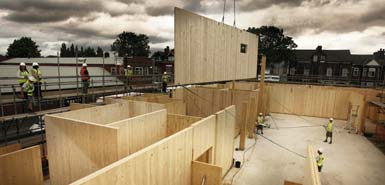
Will onsite be replaced by offsite manufacture in the future?

The recent publication by Building Futures about the future of architecture is an excellent insight into the challenges facing the industry. The report paints what I believe to be an incredibly accurate and perceptive view of our future.

The premise of the document is that there may be no architecture profession by 2025, which is an interesting argument and one I feel is close to what will be the reality of the situation.

Ultimately, I believe that the RIBA will end up representing two very different types of organisation.

At one end of the spectrum, the RIBA will represent the small general practitioners which operate in local markets on one-off niche projects. At the other end of the spectrum they will represent architects internationally – large international practices which deliver high profile complex schemes around the world.

Those medium-sized architects face the future of a diminishing marketplace. Previously, these practices have been involved in large Government programmes such as BSF or P21+. They have also delivered mixed use commercial schemes for developers across the UK.

In reality, it is no longer an option for these practices to rely on the Government for work, as the marketplace and requirement for these schemes is disappearing fast. Such organisations need an ongoing growth and revenue to provide investment in training and development and to cover large overheads.

The report hints at what these practices need to do to survive. They will need to reposition themselves and do something different in the marketplace.

Their future lies in capitalising in the need for a coordinating role. The use of BIM in construction projects supports the need for a lead designer or coordinator. There is an opportunity to embrace this role however I am sure many design managers within construction businesses will attempt to take on this role for themselves.

The role of consultant engineer may also diminish as both M&E and structural sub contractors take on more and more of the technical requirement.

The medium sized practice could also look to develop products on behalf of the industry. There is an opportunity to use the design skills which architects have to produce buildings which are manufactured rather than constructed. These products can then be sold to the large contactors or direct clients. If the designers can be clever enough they could create products which depend less on constructors and more on assembly, changing the industry through an investment in innovation. Large contractors who have strong balance sheets tend not to invest in research and development and are happy to continue to deliver projects how they have always been delivered.

The final area of opportunity for these mid-range practices is on international work. Over the past 10 years many of these practices have built up a great amount of experience in designing hospitals and schools. These skills should not be wasted and can easily be exported to other parts of the world. It will mean competing on a global stage, but with the right targeted marketing there may be an opportunity to fill the gap left by the reduced spending in the UK.

There is no doubt that the prognosis for architectural practice as we know it today is not good. By 2025, the profession will be very different and many of the current medium sized practices will not exist in their current form. A number of new businesses will have been formed by the more entrepreneurial and innovative business leaders, whilst many of the others will have been absorbed by larger construction companies who have identified the need for the coordination skills which are inherent in the traditional architect.

Friday, 4 February 2011

Toby Young

The future of schools: flat pack

Last week’s comments by Toby Young and Michael Gove about the future of school design and the performance of architects has caused much controversy.

Firstly I would like to state that I am no fan of Toby Young and his particularly direct approach to communication. Neither am I a fan of the current free schools movement in that they seem to be adopted by middle class parents and will do little to improve the imbalance of life chances for young people in the UK. However, putting this all to one side, there is much for the architectural profession to learn from Toby Young’s comments and the potential for flat pack schools for the future.

Toby Young accused the architectural profession of designing expensive schools and also being arrogant in their belief that school environments did not affect learning. I totally support the fact that the schools we designed under the previous Government were far too expensive. However, to blame architects for this is unfair. The architects involved in these schools designed buildings which they were asked to design and at an average cost of £2100 per m2 the Government was happy to pay.

The waste in this process was very much down to the process from the beginning to the end. In 2002 we completed a new build high school in Northumberland. We managed a turn key solution including furniture and all IT for £900 per m2 . This was a quick design competition with a design and build contract. The school was Blyth Community College which won numerous awards and was published by the OECD as an exemplar school design. I am sure that if we designed the building again we would do it far more economically however, it does prove that from this point the process changed and costs escalated.

Toby Young also accused architects of being arrogant in their belief that school environments made a difference to learning. I have no doubt that the quality of the environment does make a difference to a student’s ability to learn, if it is only the fact that someone has shown faith by investing in quality facilities. However, the level of this investment is significant in relation to the potential improvement.

Where architects are arrogant is in their belief that they know better than educationalists in relation to what is right for young people. I have seen so many architects challenge educationalists who have been in the teaching profession for many years and suggest their thinking is wrong. This is where architects are arrogant in that they genuinely believe that they have the answers.

Where we as a profession fail is in the listening to the market. The past Government was keen to spend lots of money on one off schools. This suited the architectural profession very well and we all were rewarded for our efforts. However, now the market is saying that they want low cost buildings which are standardised. If Toby Young wants cheap schools and cheap buildings we should be looking for ways to provide it rather than fighting against his request. At the end of the day Toby Young is the client and he is the person who signs the cheques.

We should embrace Michael Gove’s view of standardisation and look to learn from Tesco, IKEA and Dixons as to how we can commoditise buildings.

Architects are so often focused on the art of architecture, which I would always support, and is important and has its place. However in the current market place we need to find ways of innovating to resolve the commercial challenges we face.

I would far rather see our energy being put into innovation across the whole industry where we work together to solve the financial challenges rather than wasting our energy on telling our clients they are wrong. I do not believe a client can ever be wrong as they ultimately pay the bills. If architects do not like a particular client they have a choice to not work with them. Too many times over the years I have heard the expression from colleagues where they tell me that they need to educate the client. This is a classic arrogant statement in that architects believe that they should be educating everyone else around them into their thinking.

We should look to commoditise our buildings more to provide better service and performance at a much lower cost. We should be looking to deliver schools for below £1000 per m2 with exceptional energy performance and construction times of a matter of weeks.

I fear for the architectural profession as it takes on clients, ignoring the opportunity to innovate and bring intelligent solutions to the market.