Showing posts with label architecture. Show all posts

Wednesday, 25 May 2011

What future for our industry?

What does the future hold for our industry?


On the front page of the Financial Times yesterday was an article about the incredible decline in construction output during 2011. Overall construction workload fell by a staggering 39%. This is the most significant fall for the past 35 years. There were turnover statistics from several of the major construction companies, including Kier and Balfour Beatty, which indicated the considerable reduction in their construction turnover in the period.


The quarterly GEP figures issued for Quarter 1 suggested that construction output was down by nearly 5% in the period. There are no regionally adjusted figures so I would anticipate that the decline in the regions is far greater as the overall figure will be bettered by investment in the South East.


This catastrophic level of change in any industry will inevitably reshape the future considerably. For the construction industry, clearly we will never go back to the past and the type of industry it was over the past 15 years will not be seen again. We are in a period of flux at present where there is little workload or revenue, but at the same time there are improvements in technology which could reshape how we design, deliver and operate buildings for the future.


All businesses are keen to set out a vision of sustainability which looks to provide steady employment and profit for those involved in the businesses, something which is clearly under considerable threat in the construction industry at present.


As I look into the future I believe it is impossible to predict where we will be in 2 or 3 years time. Long term investments are a considerable gamble with the future being so unpredictable. Many firms are shrinking their regional presences and looking to develop opportunities in the South, which will obviously drain talent from the regions. Organisations are consolidating and changing on a regular basis. International markets continue to be the lifeline of most organisations that are able to stay afloat.


This generation has never seen such a dramatic downturn, and construction leaders are drawing on much of their experience to maintain business sustainability. While it may be difficult to predict where any of us will be beyond the next 12 months, all we can hope is that when we do see a light at the end of the tunnel, the future will be different, but secure, as well as exciting and challenging. Hopefully we can all learn lessons from this period and ultimately ensure we all have a better future.


Tuesday, 1 March 2011

The Future of Architecture

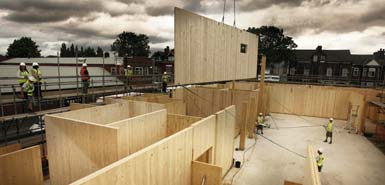
Will onsite be replaced by offsite manufacture in the future?

The recent publication by Building Futures about the future of architecture is an excellent insight into the challenges facing the industry. The report paints what I believe to be an incredibly accurate and perceptive view of our future.

The premise of the document is that there may be no architecture profession by 2025, which is an interesting argument and one I feel is close to what will be the reality of the situation.

Ultimately, I believe that the RIBA will end up representing two very different types of organisation.

At one end of the spectrum, the RIBA will represent the small general practitioners which operate in local markets on one-off niche projects. At the other end of the spectrum they will represent architects internationally – large international practices which deliver high profile complex schemes around the world.

Those medium-sized architects face the future of a diminishing marketplace. Previously, these practices have been involved in large Government programmes such as BSF or P21+. They have also delivered mixed use commercial schemes for developers across the UK.

In reality, it is no longer an option for these practices to rely on the Government for work, as the marketplace and requirement for these schemes is disappearing fast. Such organisations need an ongoing growth and revenue to provide investment in training and development and to cover large overheads.

The report hints at what these practices need to do to survive. They will need to reposition themselves and do something different in the marketplace.

Their future lies in capitalising in the need for a coordinating role. The use of BIM in construction projects supports the need for a lead designer or coordinator. There is an opportunity to embrace this role however I am sure many design managers within construction businesses will attempt to take on this role for themselves.

The role of consultant engineer may also diminish as both M&E and structural sub contractors take on more and more of the technical requirement.

The medium sized practice could also look to develop products on behalf of the industry. There is an opportunity to use the design skills which architects have to produce buildings which are manufactured rather than constructed. These products can then be sold to the large contactors or direct clients. If the designers can be clever enough they could create products which depend less on constructors and more on assembly, changing the industry through an investment in innovation. Large contractors who have strong balance sheets tend not to invest in research and development and are happy to continue to deliver projects how they have always been delivered.

The final area of opportunity for these mid-range practices is on international work. Over the past 10 years many of these practices have built up a great amount of experience in designing hospitals and schools. These skills should not be wasted and can easily be exported to other parts of the world. It will mean competing on a global stage, but with the right targeted marketing there may be an opportunity to fill the gap left by the reduced spending in the UK.

There is no doubt that the prognosis for architectural practice as we know it today is not good. By 2025, the profession will be very different and many of the current medium sized practices will not exist in their current form. A number of new businesses will have been formed by the more entrepreneurial and innovative business leaders, whilst many of the others will have been absorbed by larger construction companies who have identified the need for the coordination skills which are inherent in the traditional architect.

Friday, 4 February 2011

Toby Young

The future of schools: flat pack

Last week’s comments by Toby Young and Michael Gove about the future of school design and the performance of architects has caused much controversy.

Firstly I would like to state that I am no fan of Toby Young and his particularly direct approach to communication. Neither am I a fan of the current free schools movement in that they seem to be adopted by middle class parents and will do little to improve the imbalance of life chances for young people in the UK. However, putting this all to one side, there is much for the architectural profession to learn from Toby Young’s comments and the potential for flat pack schools for the future.

Toby Young accused the architectural profession of designing expensive schools and also being arrogant in their belief that school environments did not affect learning. I totally support the fact that the schools we designed under the previous Government were far too expensive. However, to blame architects for this is unfair. The architects involved in these schools designed buildings which they were asked to design and at an average cost of £2100 per m2 the Government was happy to pay.

The waste in this process was very much down to the process from the beginning to the end. In 2002 we completed a new build high school in Northumberland. We managed a turn key solution including furniture and all IT for £900 per m2 . This was a quick design competition with a design and build contract. The school was Blyth Community College which won numerous awards and was published by the OECD as an exemplar school design. I am sure that if we designed the building again we would do it far more economically however, it does prove that from this point the process changed and costs escalated.

Toby Young also accused architects of being arrogant in their belief that school environments made a difference to learning. I have no doubt that the quality of the environment does make a difference to a student’s ability to learn, if it is only the fact that someone has shown faith by investing in quality facilities. However, the level of this investment is significant in relation to the potential improvement.

Where architects are arrogant is in their belief that they know better than educationalists in relation to what is right for young people. I have seen so many architects challenge educationalists who have been in the teaching profession for many years and suggest their thinking is wrong. This is where architects are arrogant in that they genuinely believe that they have the answers.

Where we as a profession fail is in the listening to the market. The past Government was keen to spend lots of money on one off schools. This suited the architectural profession very well and we all were rewarded for our efforts. However, now the market is saying that they want low cost buildings which are standardised. If Toby Young wants cheap schools and cheap buildings we should be looking for ways to provide it rather than fighting against his request. At the end of the day Toby Young is the client and he is the person who signs the cheques.

We should embrace Michael Gove’s view of standardisation and look to learn from Tesco, IKEA and Dixons as to how we can commoditise buildings.

Architects are so often focused on the art of architecture, which I would always support, and is important and has its place. However in the current market place we need to find ways of innovating to resolve the commercial challenges we face.

I would far rather see our energy being put into innovation across the whole industry where we work together to solve the financial challenges rather than wasting our energy on telling our clients they are wrong. I do not believe a client can ever be wrong as they ultimately pay the bills. If architects do not like a particular client they have a choice to not work with them. Too many times over the years I have heard the expression from colleagues where they tell me that they need to educate the client. This is a classic arrogant statement in that architects believe that they should be educating everyone else around them into their thinking.

We should look to commoditise our buildings more to provide better service and performance at a much lower cost. We should be looking to deliver schools for below £1000 per m2 with exceptional energy performance and construction times of a matter of weeks.

I fear for the architectural profession as it takes on clients, ignoring the opportunity to innovate and bring intelligent solutions to the market.

Thursday, 27 January 2011

It's just the beginning


How far along the road to recovery are we?


Since we returned to work after Christmas I have sensed a notable change in atmosphere and confidence across the industry.


It seems like a number of organisations are making announcements to reduce their costs since they have returned after the break.


I suspect that during 2010 many companies were hanging on, waiting for the market to improve. Unfortunately that has not happened and is unlikely to happen in the near future. I would guess that when the Directors of these companies sat down and looked at cash in the bank and opportunities going forward, some fairly drastic measures had to be taken.


Consultancies would have looked at their costs and realised the only option is to cut resource to minimise outgoings. It is clear, from the fact that there are several small to medium sized construction businesses that have gone into administration since the New Year due to cash pressures and lack of future pipeline, that in some cases, this has not been enough.


I think this process will continue right through 2011 and beyond. I think the last two to three years and the forthcoming two to three years are likely to be the most significant in construction for at least a century. There are many theories of what the impact of this reduction in construction work will be, but I hope that something positive comes out of such a negative situation.


As an industry we can hopefully embrace this period and look to find more efficient ways of delivering buildings to the highest standard.


The Government is putting huge faith in the private sector to drive recovery and with construction being one of the most significant industries in the country, clearly we will all have our part to play in the economic recovery process.

Thursday, 9 December 2010

The Largest Change Management Programme Since Victorian Times

Paul Morrell - Chief Construction Advisor: Image from www.bco.org.uk

Paul Morrell has been at it again. As part of his role for the Department for Business, Innovation and Skills, he has issued a report which has looked at the implications to the construction industry of the low carbon challenge.

His report suggests that the industry faces the largest change management programme since Victorian times if it is to meet the low carbon agenda.

The report came from the Innovation and Growth Team (IGT) which is drawn from the construction industry and is asked by the government to consider how the construction sector could meet the low carbon agenda.

The Climate Change Act requires the UK to reduce its carbon account in 2050 to at least 80% lower than the 1990 base line.

Via the report, Paul Morrell has highlighted some of the good practice which is being carried out throughout the construction industry at present. There are some excellent projects where energy is right at the heart of the project. However, I believe that this is the exception far more than it is the rule.

In the past 12 to 18 months there has been a marked change in the approach to producing energy however, the continually disjointed nature of the process means that it is difficult to deliver efficient results.

Building regulations will continue to become increasingly onerous and our present methods of construction will make it increasingly challenging to achieve these stretching targets.

Over the past 10 years, the industry has proved that, even when there is plenty of work available, it is reluctant to invest in research and development. The industry shoots itself in the foot when times get tough in that it drives cost down without innovation.

Companies such as Laing O’Rourke have invested massively in research and development however, to continue this they need a considerable level of turnover. As part of the report there were some very nice platitudes from some Ministers stating how important the carbon issue would be to the construction industry.

I do not believe the industry will make this investment itself as it is naturally conservative and fearful of change, and the race for growth without investment is very raw to the industry at present following the spectacular demise of Connaught and Rok.

There is no incentive for the construction industry to invest in reducing energy and certainly if there is no commercial benefit to clients they are unlikely to invest themselves.

For us to get the significant improvements we need in energy performance, the Government needs to legislate to achieve these stretching targets. There will be kickback from the industry claiming the targets cannot be achieved however, this pressure will drive the industry to find ways to solve the problems.

Businesses who respond positively should be rewarded by the legislation and those who don’t should be penalised.

Unfortunately I do not have the answers to how this can be carried out but I do know that without it the industry will continue to progress as it always has done, with organisations continuing to undercut each other to win the next project.

Monday, 13 September 2010

Wanted - 100,000 School Places

Students will have to work harder in overcrowded classrooms if changes aren't made - image from _space group.

Recent research has revealed that England is facing an acute shortage in the number of school places, with more than 1 in 10 pupils in the country in schools suffering from overcrowding.

The suggestion is that the government will need to build a total of more than 100,000 places at primary and secondary schools, at a cost of up to £2bn. 50,000 of these places are required just to alleviate overcrowding, while the other 50,000 are places that local government officials have estimated will be needed to prevent the spread of overcrowding.

This overcrowding is driven by attempts by Local Authorities to cope with the lack of good schools in their boundaries. Popular schools are being allowed to grow beyond their buildings’ limits, so that as many families as possible get a place at their first choice institution. This means that already full schools will be unable to expand to meet demand as pupil places continue to rise, and larger shares of children will need to take up places at less successful schools.

Not only could a lack of classrooms force schools to increase class sizes, it also threatens to undermine the government’s plans to boost competition in education, which appears to depend on spare capacity for children to move between schools.

Currently, more than ¾ million children, 12% of the total in Local Authority schools, are in buildings that are more than 4% over the capacity for which they were designed. Among these children, more than 250,000 are in schools that are 10% over the limits of their facilities, while over 60,000 are in schools that have 20% more students than their buildings are intended for.

Considering that the amount of four year olds is set to rise by 8% over the next two years, this issue will only get worse, and in order to prevent overcrowding, Local Authorities will need to find another 25,000 new primary school places, with similar numbers for secondary schools required by 2014/15.

These growth numbers will be problem for a new education secretary who is planning wide-ranging reforms. His reforms are intended to increase the competition among schools. However this relies on a margin of spare capacity and new link choices to be made.

Apparently the school places crunch is not evenly distributed with London suffering particularly badly. The previous government had identified indentified investment for Local Authorities facing the shortage of primary school places and Building Schools for the Future was intended to be the long term answer to this issue.

Obviously, there was a bit of political too-ing and fro-ing on this issue, however there can be no doubt that the overcrowding is increasing and that this is likely to be a political timebomb. Clearly, there needs to be a stand back in relation to education building provision and how this aligns with ambitions, policy and performance of schools.
Rob

Friday, 17 July 2009

Batten Down the Hatches

Over recent months one of the terms which I keep hearing in our industry and in particular from architects is that they plan to ‘batten down the hatches’ and ‘ride out the storm’. I think in the past this has been the way many architectural businesses have responded to recessions and generally the profession is badly hit by such down turns. Much of this is caused by the fact architects depend upon capital spending and in recessions this is one of the first things to be cut.

Over the past decade our industry has made huge strides forwards in relation to its approach and technology. There is no doubt that there is still further to go but my worry is that much of the hard work we have done in relation to partnering or integrated working will be stopped and potentially be forgotten.

As an industry we need to continue to invest in training and development.. With Building Information Modelling and integrated project delivery we are on the cusp of a revolution. Unfortunately many companies are battening down the hatches and cannot afford to invest.

I also worry that by battening down the hatches the storm will happen around us and when many companies open the hatches there will be no industry left.

At _space we made the decision to think very carefully about how we move forward but do not intend to batten down the hatches or bury our heads in the sand. We will continue to invest in our people and technology and think differently about our industry.

Hopefully this will stand us in good stead for the future and in fact help us weather the storm.

We are always looking at how we can diversify our offer to enable us to sustain our business for the long term.