Wednesday, 25 May 2011

What future for our industry?

What does the future hold for our industry?


On the front page of the Financial Times yesterday was an article about the incredible decline in construction output during 2011. Overall construction workload fell by a staggering 39%. This is the most significant fall for the past 35 years. There were turnover statistics from several of the major construction companies, including Kier and Balfour Beatty, which indicated the considerable reduction in their construction turnover in the period.


The quarterly GEP figures issued for Quarter 1 suggested that construction output was down by nearly 5% in the period. There are no regionally adjusted figures so I would anticipate that the decline in the regions is far greater as the overall figure will be bettered by investment in the South East.


This catastrophic level of change in any industry will inevitably reshape the future considerably. For the construction industry, clearly we will never go back to the past and the type of industry it was over the past 15 years will not be seen again. We are in a period of flux at present where there is little workload or revenue, but at the same time there are improvements in technology which could reshape how we design, deliver and operate buildings for the future.


All businesses are keen to set out a vision of sustainability which looks to provide steady employment and profit for those involved in the businesses, something which is clearly under considerable threat in the construction industry at present.


As I look into the future I believe it is impossible to predict where we will be in 2 or 3 years time. Long term investments are a considerable gamble with the future being so unpredictable. Many firms are shrinking their regional presences and looking to develop opportunities in the South, which will obviously drain talent from the regions. Organisations are consolidating and changing on a regular basis. International markets continue to be the lifeline of most organisations that are able to stay afloat.


This generation has never seen such a dramatic downturn, and construction leaders are drawing on much of their experience to maintain business sustainability. While it may be difficult to predict where any of us will be beyond the next 12 months, all we can hope is that when we do see a light at the end of the tunnel, the future will be different, but secure, as well as exciting and challenging. Hopefully we can all learn lessons from this period and ultimately ensure we all have a better future.


Tuesday, 10 May 2011

The big housing question

I have been inspired to write this blog entry following a recent episode of Panorama. The programme was all about the need for affordable housing across the UK. There was a shocking contrast of housing in London which was fraudulently being let by landlords at extortionate rates and a family of 9 in Sheffield living in a 3 bedroom house.


There are around 5 million people on the housing waiting list in the UK and it was clear that the majority of people on this waiting list have no chance of being housed. During the show, Portsmouth Council went through their own list contacting most of the people on it, informing them that there was no chance of them ever being housed by the Authority. This meant that they cut their list considerably.


The big question however, is what happens to the people who will never be housed?


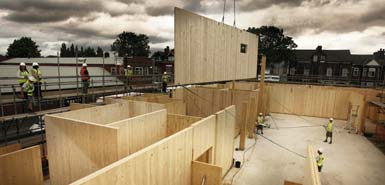
We have been developing Spacehus as a potential product for this market and we have managed to get a 3 bedroom house at an all in cost of around £84k on a small development. The running costs of this house would be around £10 per week which also would go some way to address fuel poverty.


A concept image of the £84k Spacehus that could help solve the affordable housing issue


The challenge is however, encouraging RSLs to develop. I have spent the last few months talking to many RSLs, and there is not ability or desire to develop new homes. This therefore means that the market is stagnant, so as no improvement is being made in relation to the waiting list, we face the problem of it getting longer.


It seems the reasons the RSLs are reluctant to develop is that they have been familiar with the grant process and the Government is now encouraging to change models and progress with an affordable rent model, which seems to increase their risk considerably in the longer term. All the details are not clear at present and I hope that I can dig deeper to understand what the problem is and to try and find a way around the challenges and encourage take up.


It does seem however, that there is a standoff between the Government and Social Landlords, meaning that we have a growing housing crisis in the UK.


Land values continue to be unrealistic and planning continues to be challenging. Both of these are preventing private sector involvement, putting the market in stalemate.


I still remain convinced, with my entrepreneurial hat on, that there is a need for housing which is affordable to buy or rent and run. At _space group we will continue to invest in finding a solution to this problem, until we find a way of getting affordable sustainable homes delivered.


For a number of years, we at _space group we have been driven by the purpose of making life better. After watching Panorama, I am sure that if we manage to crack this problem we will definitely make life better for the family in Sheffield who are currently sleeping on the settee.

Wednesday, 23 March 2011

What a Difference a Year Makes...


Michael Gove was the keynote speaker at The Spectator's "The Schools Revolution One Year On" conference

I recently attended the Spectator Conference in London entitled ‘The Schools Revolution one year on’.

This event was held last year in advance of the General Election, and what was interesting this year was the number of teachers and educationalists at the conference and the lack of architects and construction people, despite the fact that The Spectator is a big advocate of Free Schools and Toby Young is on their payroll…

From the line up at this event, with Michael Gove delivering the keynote address, David Laws bringing the Lib Dems’ point of view to the table and Lord Adonis and Tim Byles attending, it was clear that it was supported by like-minded people who are in general in support of the Free Schools movement.

Michael Gove came across well, and I was surprised that he does have a sense of humour. He focused on three key areas as priorities, these being accountability, independence and teaching. He talked very little about new buildings or IT. It seems he is wedded to the private school model and is hoping to encourage schools to take this approach across the curriculum with the introduction of an English baccalaureate.

It felt like a very one-sided conference, supporting academies and free schools. Many of the arguments were valid, and I was encouraged by the focus on improving teaching and a zero tolerance policy of poorly performing teachers, however I still maintain the big difference between state schools and private schools is the commitment of the parents and not the ability of the children.

It is clear that the Government’s focus is no longer on buildings and the statement from Tim Byles was that buildings had to no longer be inspirational, but fit for purpose. This does seem to be setting the bar fairly low and I think that it is a missed opportunity.

What we have to do in our industry is to deliver inspirational learning spaces within the parameters which we have been set, and which this conference reinforces. Only time will tell if the new approach is a success, but so much has changed in the past year, and I am intrigued to see where the schools agenda will be this time next year.

Tuesday, 1 March 2011

The Future of Architecture

Will onsite be replaced by offsite manufacture in the future?

The recent publication by Building Futures about the future of architecture is an excellent insight into the challenges facing the industry. The report paints what I believe to be an incredibly accurate and perceptive view of our future.

The premise of the document is that there may be no architecture profession by 2025, which is an interesting argument and one I feel is close to what will be the reality of the situation.

Ultimately, I believe that the RIBA will end up representing two very different types of organisation.

At one end of the spectrum, the RIBA will represent the small general practitioners which operate in local markets on one-off niche projects. At the other end of the spectrum they will represent architects internationally – large international practices which deliver high profile complex schemes around the world.

Those medium-sized architects face the future of a diminishing marketplace. Previously, these practices have been involved in large Government programmes such as BSF or P21+. They have also delivered mixed use commercial schemes for developers across the UK.

In reality, it is no longer an option for these practices to rely on the Government for work, as the marketplace and requirement for these schemes is disappearing fast. Such organisations need an ongoing growth and revenue to provide investment in training and development and to cover large overheads.

The report hints at what these practices need to do to survive. They will need to reposition themselves and do something different in the marketplace.

Their future lies in capitalising in the need for a coordinating role. The use of BIM in construction projects supports the need for a lead designer or coordinator. There is an opportunity to embrace this role however I am sure many design managers within construction businesses will attempt to take on this role for themselves.

The role of consultant engineer may also diminish as both M&E and structural sub contractors take on more and more of the technical requirement.

The medium sized practice could also look to develop products on behalf of the industry. There is an opportunity to use the design skills which architects have to produce buildings which are manufactured rather than constructed. These products can then be sold to the large contactors or direct clients. If the designers can be clever enough they could create products which depend less on constructors and more on assembly, changing the industry through an investment in innovation. Large contractors who have strong balance sheets tend not to invest in research and development and are happy to continue to deliver projects how they have always been delivered.

The final area of opportunity for these mid-range practices is on international work. Over the past 10 years many of these practices have built up a great amount of experience in designing hospitals and schools. These skills should not be wasted and can easily be exported to other parts of the world. It will mean competing on a global stage, but with the right targeted marketing there may be an opportunity to fill the gap left by the reduced spending in the UK.

There is no doubt that the prognosis for architectural practice as we know it today is not good. By 2025, the profession will be very different and many of the current medium sized practices will not exist in their current form. A number of new businesses will have been formed by the more entrepreneurial and innovative business leaders, whilst many of the others will have been absorbed by larger construction companies who have identified the need for the coordination skills which are inherent in the traditional architect.

Friday, 4 February 2011

Toby Young

The future of schools: flat pack

Last week’s comments by Toby Young and Michael Gove about the future of school design and the performance of architects has caused much controversy.

Firstly I would like to state that I am no fan of Toby Young and his particularly direct approach to communication. Neither am I a fan of the current free schools movement in that they seem to be adopted by middle class parents and will do little to improve the imbalance of life chances for young people in the UK. However, putting this all to one side, there is much for the architectural profession to learn from Toby Young’s comments and the potential for flat pack schools for the future.

Toby Young accused the architectural profession of designing expensive schools and also being arrogant in their belief that school environments did not affect learning. I totally support the fact that the schools we designed under the previous Government were far too expensive. However, to blame architects for this is unfair. The architects involved in these schools designed buildings which they were asked to design and at an average cost of £2100 per m2 the Government was happy to pay.

The waste in this process was very much down to the process from the beginning to the end. In 2002 we completed a new build high school in Northumberland. We managed a turn key solution including furniture and all IT for £900 per m2 . This was a quick design competition with a design and build contract. The school was Blyth Community College which won numerous awards and was published by the OECD as an exemplar school design. I am sure that if we designed the building again we would do it far more economically however, it does prove that from this point the process changed and costs escalated.

Toby Young also accused architects of being arrogant in their belief that school environments made a difference to learning. I have no doubt that the quality of the environment does make a difference to a student’s ability to learn, if it is only the fact that someone has shown faith by investing in quality facilities. However, the level of this investment is significant in relation to the potential improvement.

Where architects are arrogant is in their belief that they know better than educationalists in relation to what is right for young people. I have seen so many architects challenge educationalists who have been in the teaching profession for many years and suggest their thinking is wrong. This is where architects are arrogant in that they genuinely believe that they have the answers.

Where we as a profession fail is in the listening to the market. The past Government was keen to spend lots of money on one off schools. This suited the architectural profession very well and we all were rewarded for our efforts. However, now the market is saying that they want low cost buildings which are standardised. If Toby Young wants cheap schools and cheap buildings we should be looking for ways to provide it rather than fighting against his request. At the end of the day Toby Young is the client and he is the person who signs the cheques.

We should embrace Michael Gove’s view of standardisation and look to learn from Tesco, IKEA and Dixons as to how we can commoditise buildings.

Architects are so often focused on the art of architecture, which I would always support, and is important and has its place. However in the current market place we need to find ways of innovating to resolve the commercial challenges we face.

I would far rather see our energy being put into innovation across the whole industry where we work together to solve the financial challenges rather than wasting our energy on telling our clients they are wrong. I do not believe a client can ever be wrong as they ultimately pay the bills. If architects do not like a particular client they have a choice to not work with them. Too many times over the years I have heard the expression from colleagues where they tell me that they need to educate the client. This is a classic arrogant statement in that architects believe that they should be educating everyone else around them into their thinking.

We should look to commoditise our buildings more to provide better service and performance at a much lower cost. We should be looking to deliver schools for below £1000 per m2 with exceptional energy performance and construction times of a matter of weeks.

I fear for the architectural profession as it takes on clients, ignoring the opportunity to innovate and bring intelligent solutions to the market.

Thursday, 27 January 2011

It's just the beginning


How far along the road to recovery are we?


Since we returned to work after Christmas I have sensed a notable change in atmosphere and confidence across the industry.


It seems like a number of organisations are making announcements to reduce their costs since they have returned after the break.


I suspect that during 2010 many companies were hanging on, waiting for the market to improve. Unfortunately that has not happened and is unlikely to happen in the near future. I would guess that when the Directors of these companies sat down and looked at cash in the bank and opportunities going forward, some fairly drastic measures had to be taken.


Consultancies would have looked at their costs and realised the only option is to cut resource to minimise outgoings. It is clear, from the fact that there are several small to medium sized construction businesses that have gone into administration since the New Year due to cash pressures and lack of future pipeline, that in some cases, this has not been enough.


I think this process will continue right through 2011 and beyond. I think the last two to three years and the forthcoming two to three years are likely to be the most significant in construction for at least a century. There are many theories of what the impact of this reduction in construction work will be, but I hope that something positive comes out of such a negative situation.


As an industry we can hopefully embrace this period and look to find more efficient ways of delivering buildings to the highest standard.


The Government is putting huge faith in the private sector to drive recovery and with construction being one of the most significant industries in the country, clearly we will all have our part to play in the economic recovery process.

Thursday, 6 January 2011

2011 - A Challenge or an Opportunity


Christmas - traditionally a time of excess. Will it be the case in 2011?

As I recovered from the excesses of Christmas and New Year, reading the press and watching the news, I gradually felt myself slipping into a state of depression.

The media have jumped on the band wagon of how bad 2011 is going to be. The word ‘challenge’ has been used countless times with reference to the next 12 months. As increased fuel prices are coupled with the challenges of an economic downturn, it appears doom and gloom loom large for us.

This sentiment was reinforced even further with Tuesday’s VAT rise – another fantastic opportunity for the media to ram home how bad life is going to be for us all. This incessant drive from the media to convince the whole country that the future is going to be dreadful casts a huge cloud over everyone. So, taking all of this in over the festive period, it could have been for me easy to reflect and think how depressing the forthcoming year is going to be.

However, with this perspective Christmas 2011 is going to be a long way away and every week is going to feel like a month. For those who believe that the glass is half empty, this burden is going to wear heavy for a considerable time and I do worry for the mental health of the whole country as the recession continues to be sustained.

As we all returned to _space group, this week I, was keen to look at the positives of the current situation. Whilst undoubtedly, the environment is changing and there will be cuts in spending in some areas, this can also be considered as an opportunity. Certainly these changes are significant enough to force new thinking in the construction industry. Our clients need and expect large percentage savings off their capital expenditure and the increase in energy costs is forcing us to make our buildings perform better.

All of this will encourage our industry to look for new ways of delivering our services and improve the outputs from what has been an underperforming industry.

I was very keen to communicate this positive outlook to everyone across _space group when I returned so that we can start the year in the right frame of mind with the energy to take us through what will be a different 2011. With our eyes open to opportunity hopefully we can carry our business forward for many years to come, through investing in the future and thinking about innovation.